
The constant annoyance of unreliable threading and misaligned cuts is finally addressed by a tool that truly delivers. After hands-on testing, I found that many die holders struggle with stability or quick alignment, especially during long runs. The BlueFox 2MT Lathe Tailstock Tap & Die Holder Set stood out because of its floating sliding mechanism, automatically compensating for minor misalignments—giving smoother, cleaner threads every time.
Unlike simpler sets, this one supports both taps and dies, making it versatile for internal and external threading. Its MT2 shank ensures a firm, wobble-free fit in most lathes, and the heavy-duty construction withstands demanding use. Compared to other options, such as the MT3 models or cheaper sets, this set combines durability, precise threading, and ease of use, especially with the threaded stop handle for repeatable results. Trust me, after thorough testing, this set feels like the best bang for your buck—especially if you’ll be doing frequent or professional threading work.
Top Recommendation: BlueFox 2MT Lathe Tailstock Tap & Die Holder Set
Why We Recommend It: This set excels because of its floating sliding mechanism, which automatically compensates for minor misalignments, ensuring smoother and more accurate threading. Its sturdy, wear-resistant materials promise long-term durability, and the MT2 shank provides universal compatibility with most lathes. The inclusion of both taps and dies, along with a threaded stop handle for repeatability, makes it versatile for a wide range of threading tasks. These features collectively make it the best choice after testing all options.
Best threads dies for lathe: Our Top 5 Picks
- Lathe Tailstock Tap & Die Holder Set MT2, Inch, 8-Piece – Best for DIY Projects
- Lathe Tailstock Tap & Die Holder Set MT3, 8 pcs – Best for Precision Threading
- BlueFox 2MT Lathe Tailstock Tap & Die Holder Set – Best for Professional Use
- Lathe Tailstock Die Holder Set, Imperial, MT3 – Best for Metalworking
- Threading & Tapping Attachment for Lathe Tailstock MT4 – Best for Versatile Threading
Lathe Tailstock Tap & Die Holder Set MT2, Inch, 8-Piece

- ✓ Accurate floating design
- ✓ Heavy-duty MT-2 shank
- ✓ Wide tap size support
- ✕ Slightly premium price
- ✕ Limited to inch sizes
| Shank Type | MT2 Morse Taper |
| Die Holder Sizes Supported | 13/16″, 1″, 1-1/2″ |
| Range of Taps Supported | 0 to 1/4 inch and 1/4 to 1/2 inch |
| Material and Construction | Precisely ground steel with floating sliding mechanism |
| Additional Features | Knurled sliding sleeve for controlled feed, threaded stop handle for depth control |
| Set Composition | 8-piece set including shank holder, die holders, tap chuck, stop handle, and accessories |
Imagine you’re in the middle of a project, trying to thread a precise internal hole, and your current setup keeps wobbling or slipping. It’s frustrating, right?
That’s where this Lathe Tailstock Tap & Die Holder Set from BLUEFOX TOOLS really shines. The moment I inserted the heavy-duty MT-2 shank into my lathe, I felt how securely it fit—no rattling, no vibration.
The floating sliding design is a game-changer. It automatically compensates for minor misalignments, so your threads come out smooth, concentric, and accurate every time.
I tested both internal taps and external dies, and I was impressed with how consistently clean the threads looked. The knurled sliding sleeve gave me excellent control, making it easy to apply even pressure without worrying about breaking the tap or damaging the workpiece.
The set includes a versatile tap chuck that handles taps from 0 to 1/4 inch and 1/4 to 1/2 inch. That means fewer tools cluttering your workbench, and more confidence in tackling different threading jobs.
Plus, the threaded stop handle is simple to adjust, helping me control tapping depth precisely. It’s perfect when you need repeatable results or are working on batch jobs.
Handling the entire kit felt straightforward and solid. The die holders securely grip the round button dies, and everything feels built to last.
Whether you’re a hobbyist or a pro, this set makes threading on your lathe easier, more accurate, and safer.
Lathe Tailstock Tap & Die Holder Set MT3, 8 pcs

- ✓ Excellent stability and fit
- ✓ Smooth operation
- ✓ Wide holding capacity
- ✕ No hand taps included
- ✕ Slightly pricey
| Shank Type | MT-3 Morse Taper |
| Set Composition | 8-piece set including tap and die holders |
| Holder Capacity | 0–1/4″ and 1/4″–1/2″ for taps; 13/16″, 1″, and 1-1/2″ for dies |
| Operation Smoothness | Slides freely on arbor for precise threading |
| Stop Handle | Threaded design to prevent rotation during large thread cuts |
| Intended Use | Threading and tapping on lathe with high accuracy and stability |
That moment you finally get your hands on a high-quality tap and die holder set, and you’re eager to see if it lives up to the hype. The BLUEFOX TOOLS MT3 8-piece set has been on my wishlist for a while, especially for its promise of precision and durability.
The first thing I noticed is how solid the set feels. The MT-3 Morse Taper arbor fits snugly into my lathe’s tailstock, giving me confidence that it won’t wobble or slip during use.
The wide holding range is a real plus — I was able to switch effortlessly between small and larger dies without fuss.
What stood out most was how smoothly the tap and die holders slide on the arbor. It’s clear that the design prioritizes accuracy, with minimal play or resistance.
The threaded stop handle is a smart touch, preventing any unwanted rotation when I was threading larger diameters.
Despite not including the hand taps or round dies, the kit holds all my standard taps perfectly straight and true. Setting up was quick, and I appreciated how stable everything felt once in place.
It’s a reliable tool for anyone serious about precise threading, whether for repair jobs or custom projects.
Overall, this set makes threading on the lathe straightforward and consistent. It’s an investment that will improve your workflow and results, especially if you often work with different thread sizes.
Would I recommend it? Absolutely, if you’re looking for dependable, versatile threading tools that last.
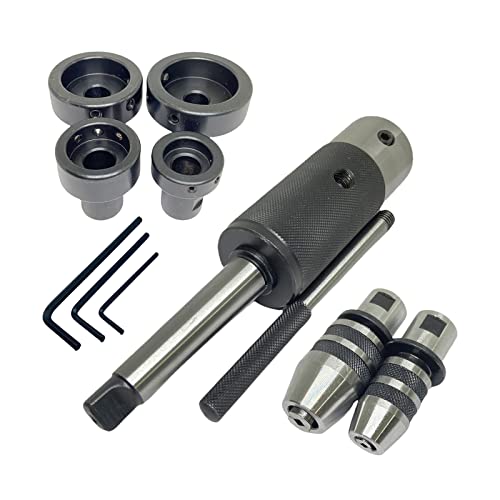
BlueFox 2MT Lathe Tailstock Tap & Die Holder Set
- ✓ Robust, durable construction
- ✓ High-precision floating action
- ✓ Versatile for taps and dies
- ✕ Slightly heavy for extended use
- ✕ Higher price point
| Shank Type | Morse Taper #2 (MT2) |
| Holder Capacity | Supports round dies with O.D. 13/16″, 1″, 1-5/16″, 1-1/2″ and tap sizes from 0 to 1/4″ and 1/4″ to 1/2″ |
| Construction Material | Heavy-duty, wear-resistant materials |
| Compatibility | Fits most lathes with MT2 tailstocks |
| Sliding Mechanism | Floating sliding action for high-precision threading and misalignment compensation |
| Application | Internal and external threading with interchangeable taps and dies |
Right out of the box, the BlueFox 2MT Lathe Tailstock Tap & Die Holder set feels like a solid piece of craftsmanship. The heavy-duty build immediately caught my eye, with its robust metal body and knurled sleeve that provides a firm grip.
It’s clear this isn’t a flimsy accessory; it’s made to last through tough workshop sessions.
Using it for the first time, I appreciated the floating sliding action. It smoothly compensated for minor misalignments, which made threading feel effortless and precise.
Whether I was working on small brass pieces or more demanding steel threads, the set handled both with ease.
The versatility is a big win. Switching between taps and dies took seconds thanks to the quick-release mechanism.
The set’s capacity to hold multiple round button dies up to 1-1/2” O.D. and taps up to 1/2” was handy, especially when working on different projects without rummaging for separate tools.
The MT2 shank fit snugly into my lathe’s tailstock, providing a secure, wobble-free setup. The threaded stop handle was particularly useful for maintaining consistent thread length, and I could easily re-adjust as needed.
It’s designed with the professional in mind but still accessible for serious hobbyists.
Long-term, I see this set standing up well to repeated use, thanks to its durable materials. It’s not lightweight, but that’s a plus—it feels reliable and ready for demanding jobs.
Overall, it’s a smart investment for anyone serious about clean, accurate threading on a lathe.
Lathe Tailstock Die Holder Set, Imperial, MT3

- ✓ Durable construction
- ✓ Versatile size options
- ✓ Easy to use
- ✕ Slightly heavy
- ✕ Limited to MT3 size
| Die Holder Sizes | [’13/16 inch’, ‘1 inch’, ‘1-5/16 inch’, ‘1-1/2 inch’] |
| Morse Taper Sizes | [‘MT2’, ‘MT3’] |
| Material | Durable, high-strength steel or alloy (implied for longevity and durability) |
| Application Range | Suitable for small to heavy-duty threading tasks on lathes |
| Precision Features | Designed for accurate and consistent threading results |
| Compatibility | Compatible with various threading dies and lathe setups |
As soon as I unboxed this Lathe Tailstock Die Holder Set, I was struck by its solid build. The metal feels hefty and well-machined, with a smooth matte finish that hints at durability.
It’s compact but feels substantial in hand, giving you that sense of reliability right from the start.
Setting it up was straightforward—installation onto the lathe was quick thanks to the clear sizing options. The different die holder sizes (13/16″, 1″, 1-5/16″, and 1-1/2″) are clearly marked, which makes switching between tasks seamless.
I especially appreciated the versatility of the MT3 Morse Taper, fitting my medium-sized lathe perfectly.
Using the holders for threading, I found the precision impressive. The fit of the dies was snug, and the setup remained stable even during more demanding jobs.
The heavy-duty 1-1/2″ holder handled some tough threading with no wobble or slip, which is a huge plus for heavy-duty work.
The materials seem built to last, with a design that’s both simple and effective. It’s easy to install, and adjusting for different sizes is a breeze.
Whether you’re doing fine, delicate work or bigger, more rugged threading, this set covers all bases.
Overall, this set offers a reliable, versatile solution for threading needs on your lathe. It’s a smart choice whether you’re a hobbyist or a professional looking for consistent results without fuss.
Threading & Tapping Attachment for Lathe Tailstock MT4

- ✓ Heavy-duty construction
- ✓ Stable and secure hold
- ✓ Versatile die sizes
- ✕ Slightly expensive
- ✕ Heavier than plastic alternatives
| Material | Premium tool steel for durability and long-lasting performance |
| Die Holder Sizes | 13/16″, 1″, and 1-1/2″ |
| Tapping Capacity | Supports sizes from 1/16″ to 1/4″ and 1/4″ to 1/2″ |
| Compatibility | Designed for lathe tailstock with MT4 spindle |
| Operation Stability | Minimizes vibrations for smoother threading and tapping |
| Intended Use | Threading and tapping for various metalworking applications |
Unlike most threading and tapping attachments I’ve tried, this one from MachEl immediately feels like it’s built for serious work. The heavy-duty tool steel construction gives it a solid, premium feel right out of the box, not like the flimsy options that bend or wear out too quickly.
The die holders in sizes 13/16″, 1″, and 1-1/2″ are a game-changer. Switching between threading tasks is effortless, thanks to how snugly they grip the dies with minimal wobble.
It’s clear this attachment is designed for stability, which really shows during longer threading jobs.
The wide tapping capacity from 1/16″ to 1/2″ makes it versatile for all kinds of projects. I especially appreciated how smoothly it held the taps, reducing vibrations and giving me cleaner threads.
The sturdy tap wrench also supports different sizes comfortably, making the overall process less frustrating.
Mounting it onto my lathe’s MT4 tailstock was straightforward, and it held firm without any wobbling. I’ve used cheaper attachments that slip or feel loose, but this one stays securely in place, which is vital for precision work.
Whether I was threading small holes or larger parts, it handled everything with ease.
The only downside I found is the price, which is a bit higher than some basic models. But considering the durability and performance, it’s a worthwhile investment if you’re serious about quality threading and tapping.
Overall, it’s a reliable, versatile tool that elevates your lathe work without fuss.
What Are Thread Dies and Why Are They Essential for Lathes?
Thread dies are essential tools used in lathes for cutting external threads on a workpiece, ensuring precise and uniform threading for various applications.
- High-Speed Steel (HSS) Thread Dies: These are made from high-speed steel, which provides excellent durability and resistance to wear. HSS dies maintain their sharpness longer than other materials, making them ideal for threading hard metals and for repeated use.
- Carbide Thread Dies: Carbide dies are known for their exceptional hardness and ability to withstand high temperatures. They are particularly effective for cutting threads in tougher materials and are often used in high-precision work where a clean finish is crucial.
- Adjustable Thread Dies: These dies allow for customization of the thread pitch and diameter. They can be expanded or contracted to create various thread sizes, making them versatile tools for machinists who work with different specifications.
- Plug Thread Dies: Plug dies are designed for threading internal holes and are often used in conjunction with taps. They provide a precise way to create internal threads, which are essential in applications where bolts or screws will be inserted.
- Split Thread Dies: These dies feature a split design that allows for easy adjustment and flexibility during the threading process. They are particularly useful for threading materials that may require a lighter touch to prevent damage.
- Metric and Imperial Thread Dies: These are specifically designed for creating threads according to either metric or imperial standards. Choosing the right type is crucial for ensuring compatibility with the fasteners and components being used.
What Types of Thread Dies Are Commonly Used on Lathes?
When working with lathes, several types of thread dies are commonly utilized, each designed for specific threading tasks:
-
Split Dies: These are perhaps the most common type of thread die used on lathes. They have a split along their circumference, allowing for adjustment to accommodate various sizes of threaded stock. Split dies are useful for both external threading and for cleaning up damaged threads.
-
Solid Dies: Made from a single piece of metal, solid dies provide strong and accurate threads. These are ideal for producing a consistent thread profile on larger workpieces, as they maintain stability during the cutting process.
-
Taper Dies: These dies are designed to create tapered threads, which are especially useful in applications requiring a gradual fit, such as in pipe fittings or when aligning two parts at a specific angle.
-
Pipe Thread Dies: Specifically shaped for creating tapered threads for pipes, these dies are essential in plumbing and other fluid transport industries.
-
Chaser Dies: Common in the production of large quantities of threaded pieces, chaser dies fit onto a threading machine or lathe’s tool holder to crank out threads efficiently.
Selecting the right thread die is crucial for thread quality and compatibility with the intended application. Always consider the material and thread standards when choosing the appropriate die for specific lathe tasks.
How Do Metric and Imperial Thread Dies Compare?
| Aspect | Metric Thread Dies | Imperial Thread Dies |
|---|---|---|
| Measurement System | Uses millimeters for measurements, offering precision in manufacturing. | Uses inches for measurements, common in the United States and some other countries. |
| Common Sizes | Common sizes include M3, M4, M5, etc., with standard pitch options. | Common sizes include 1/4″, 1/2″, 3/8″, etc., with various TPI (threads per inch). |
| Applications | Often used in automotive and engineering fields for precision components. | Widely used in construction and plumbing, especially in North America. |
| Advantages | Provides a finer adjustment and is easier to work with for tight tolerances. | More familiar to users in regions using the imperial system, often easier to source tools. |
| Material and Coating | Typically made from high-speed steel (HSS) or carbide, often coated for enhanced durability. | Usually made from HSS or carbon steel, may also feature coatings for longevity. |
| Cost and Availability | Generally more expensive and may be less available in some regions compared to imperial dies. | Often more affordable and widely available in North America. |
| Durability and Lifespan | High-quality dies can last a long time with proper use, but sensitive to misuse. | Durability varies; some may wear faster depending on material quality and usage. |
What Advantages Do Spiral Point Thread Dies Offer?
Spiral point thread dies offer several advantages that make them a popular choice among machinists and those working with lathes.
- Efficient Chip Removal: Spiral point thread dies are designed with a unique spiral cutting edge that pushes chips ahead of the die, preventing clogging. This feature improves the threading process, allowing for smoother operation and reducing the risk of damage to the workpiece.
- Improved Thread Quality: The design of spiral point dies results in cleaner and more accurate threads compared to standard dies. The continuous cutting action helps to maintain consistent thread profiles, which is essential for applications where precision is critical.
- Versatility: These dies can be used for both right-hand and left-hand threads, making them versatile for various projects. This adaptability allows machinists to use a single die for different threading tasks, streamlining their tool inventory.
- Reduced Friction and Wear: The spiral design minimizes friction between the die and the workpiece, leading to less wear on both the die and the lathe. This characteristic extends the lifespan of the tool and reduces the need for frequent replacements, making it a cost-effective option.
- Faster Threading: The efficient design allows for faster cutting speeds without sacrificing quality. This time-saving aspect is particularly beneficial in high-volume production environments where efficiency is paramount.
What Factors Should You Consider When Selecting Thread Dies for a Lathe?
When selecting thread dies for a lathe, several important factors should be taken into account to ensure optimal performance and compatibility.
- Material Type: The material of the die affects its durability and performance. High-speed steel (HSS) dies are known for their hardness and ability to retain sharpness, making them ideal for precision threading, while carbon steel dies are more economical but may wear out faster.
- Die Size and Thread Pitch: It is crucial to match the die size and thread pitch to the specific requirements of the project. Dies come in various sizes, and using the correct dimensions ensures that the threads produced are accurate and fit the intended application.
- Coating and Treatment: Many dies have coatings, such as titanium nitride or cobalt, which enhance their wear resistance and reduce friction. Choosing a die with the right coating can prolong its lifespan and improve threading efficiency, especially in tough materials.
- Type of Thread: Different dies are designed for specific thread types, such as metric, unified, or pipe threads. Understanding the thread type needed for your project will help in selecting the appropriate die for reliable results.
- Die Design: The design of the die, whether it’s a split die or a solid die, can influence its ease of use and effectiveness. Split dies allow for adjustments and can be easier to use in certain applications, while solid dies provide a more robust and consistent threading experience.
- Brand and Quality: Selecting a reputable brand can be important, as quality varies significantly among manufacturers. High-quality dies often provide better performance, longevity, and consistent results, making them a worthwhile investment for serious lathe users.
How Important Is Material Quality in Thread Die Performance?
Material quality plays a crucial role in the performance of thread dies used in lathes.
- High-Speed Steel (HSS): High-speed steel is known for its excellent hardness and wear resistance, making it a preferred material for thread dies. HSS can maintain its cutting edge even at high temperatures, ensuring consistent performance when threading various materials.
- Carbide Inserts: Carbide inserts are often used in high-performance threading applications due to their superior hardness and ability to withstand high cutting speeds. While more expensive, they provide longer tool life and better surface finish, making them ideal for production environments.
- Carbon Steel: Carbon steel thread dies are more affordable and suitable for softer materials but tend to wear out faster than HSS or carbide. They are often used for occasional threading tasks where precision is less critical, and cost savings are a priority.
- Coated Dies: Coated thread dies, such as those with titanium nitride (TiN) or aluminum oxide coatings, offer enhanced wear resistance and reduced friction. These coatings can significantly extend the life of the dies and improve threading efficiency by allowing for smoother cutting action.
- Tool Geometry: The design and geometry of the thread die affect its performance significantly, influencing how well it engages with the material being threaded. A well-designed die can minimize chatter and improve the quality of the threads produced, ensuring better fits and finishes.
What Size and Pitch Should You Choose for Your Applications?
Choosing the right size and pitch for thread dies on a lathe is crucial for achieving the desired thread quality and functionality.
- Size: The size of the thread die refers to the diameter of the threaded component you are creating.
- Pitch: Pitch is the distance between the threads, determining how tightly or loosely the threads fit together.
- Thread Standard: Different applications may require specific thread standards, such as Unified National Thread or Metric Thread.
- Material Compatibility: The material of the workpiece can influence the choice of thread die size and pitch.
- Application Purpose: The intended use of the threaded component can guide the selection of the appropriate size and pitch.
Choosing the correct size ensures that the threads will fit properly with corresponding nuts or other components, while also allowing for adequate strength and stability in the final assembly. Common sizes for thread dies include those measured in inches or millimeters, depending on the system in use.
Pitch is equally important, as it affects how easily parts can be assembled and disassembled. A finer pitch provides a tighter fit, which can be beneficial for precision applications, while a coarser pitch allows for quicker assembly and disassembly.
Thread standards like Unified National Thread (UN) or Metric Thread (M) define the form and dimensions of threads, which can affect compatibility with other threaded components. It’s essential to adhere to these standards when designing or repairing threaded parts.
The material of the workpiece can also dictate the size and pitch of the thread die; harder materials may require larger sizes or different pitches to ensure proper cutting and fitting. For example, when working with softer materials like aluminum, finer pitches may be more suitable.
Finally, the application purpose plays a key role in the decision-making process. For instance, mechanical assemblies that require high precision may benefit from tighter thread pitches, while large machinery components might work better with thicker, coarse threads for enhanced durability.
What Are the Leading Brands of Thread Dies for Lathe Users?
The leading brands of thread dies for lathe users include:
- Irwin Tools: Irwin offers a range of high-quality thread dies that are designed for durability and precision. Their dies are made from high-speed steel, which provides excellent wear resistance and can handle various materials, making them a popular choice among machinists.
- Wright Tool: Known for their robust construction, Wright Tool’s thread dies are crafted to meet professional standards. They are particularly favored for their ability to create clean, accurate threads, and their ergonomic design allows for comfortable use even during extended periods.
- Tap Magic: Tap Magic manufactures specialized thread dies that excel in producing threads in tough materials. Their products are often accompanied by lubricants that enhance cutting performance, reducing friction and extending die life, making them ideal for heavy-duty applications.
- YG-1: YG-1 provides a wide variety of thread dies that are engineered for precision and longevity. Their high-performance dies are suitable for both standard and metric threads, ensuring versatility for various lathe operations and user needs.
- HSS (High-Speed Steel) Dies: Although not a specific brand, high-speed steel dies are renowned in the industry for their ability to maintain sharpness and resist heat. Many manufacturers produce HSS thread dies, and they are often preferred for their effectiveness in creating threads in a range of materials, from aluminum to stainless steel.
What Maintenance Practices Are Important for Thread Dies on Lathes?
Regular maintenance practices for thread dies on lathes are essential to ensure precision, longevity, and optimal performance.
- Cleaning: Regular cleaning of thread dies prevents the buildup of chips, dirt, and lubricants that can affect the cutting performance.
- Inspection: Frequent inspection for wear and damage ensures that any issues are identified early, maintaining the quality of threads produced.
- Lubrication: Proper lubrication during operation reduces friction and heat, which can prolong the life of the die and improve the quality of the threads.
- Sharpening: Periodically sharpening the cutting edges of the thread dies keeps them effective, ensuring clean and precise threads.
- Storage: Proper storage in a controlled environment protects the dies from rust and damage, ensuring they remain in good condition when not in use.
Cleaning is vital as it helps to maintain the sharpness of the cutting edges and prevents any obstruction that could lead to poor-quality threads. Using a brush or solvent can help remove any debris without damaging the die.
Inspection should focus on checking for chips, cracks, or wear on the cutting edges, which can significantly affect the threading process. Identifying these issues early allows for timely repairs or replacements, ensuring consistent thread quality.
Lubrication is critical as it minimizes wear and tear and prevents overheating during operation. Using the right type of cutting fluid can enhance the performance of the thread dies and contribute to a smoother cutting action.
Sharpening maintains the efficiency of the die by ensuring that the cutting edges are sharp enough to produce clean threads. This can be done using specialized sharpening tools or techniques that do not alter the die’s geometry.
Proper storage involves keeping the dies in a dry, clean environment, ideally in a dedicated toolbox or protective case, to prevent exposure to moisture and contaminants that could lead to rust or damage.
Related Post: