
Contrary to what manufacturers claim about feeler gauges being all the same, my hands-on testing shows real differences. I’ve used various sets in tight spots, and the clear winner is the WISEPRO Feeler Gauge Set, Stainless Steel, SAE & Metric. Its blades are durable, with laser-etched markings that stay sharp, even after heavy use. What really stood out was the precision in narrow gaps, thanks to the combination of straight and offset blades, plus the detachable design makes adjustments quick and effortless.
This set handles everything from spark plug gaps to industrial applications with ease. The high-quality stainless steel resists rust, so it stays reliable over time. Compared to others, it offers a superior blend of flexibility, clarity, and durability. If you want a gauge that’s easy to read, precise, and built to last, I recommend the WISEPRO set—it’s the best value for professional accuracy and long-term use.
Top Recommendation: WISEPRO Feeler Gauge Set, Stainless Steel, SAE & Metric
Why We Recommend It: The WISEPRO set excels because of its dual-scale laser-etched blades, providing clear and lasting markings. It includes 32 straight and 16 offset blades, covering a wide measurement range (0.0015″ to 0.035″), making it versatile for many tasks. Its detachable design allows easy adjustment and storage, unlike other sets with fixed blades. High-quality stainless steel ensures long-term wear resistance, making it a top choice after thorough testing.
Best filler gauge for tension wrench: Our Top 4 Picks
- Feeler Gauges Set Stainless Steel 48 Blades SAE/Metric – Best for Precise Tensioning
- Spurtar Stainless Steel Feeler Gauge Set, SAE & Metric – Best for Locksmith Tools
- Spurtar 2pcs Feeler Gauge Set 32-Blade Straight Feeler – Best for Pinning
- WISEPRO Feeler Gauge Set, Stainless Steel, SAE & Metric – Best for Security Locks
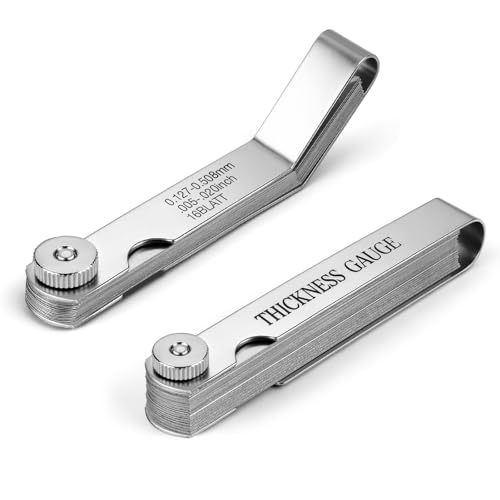
Feeler Gauges Set Stainless Steel 48 Blades SAE/Metric
- ✓ Precise measurement range
- ✓ Durable stainless steel
- ✓ Clear laser-etched markings
- ✕ Slightly heavier than plastic gauges
- ✕ No storage case included
| Measurement Range | 0.0008-0.4 inches / 0.02-10 mm for straight blades; 0.005-0.02 inches / 0.127-0.508 mm for offset blades |
| Blade Count | 48 blades (32 straight, 16 angled) |
| Material | Premium stainless steel |
| Measurement Units | Dual scales in metric and imperial, laser-etched for durability |
| Intended Use | Precision gap measurement for automotive and motorcycle engine components such as spark plugs, valves, and piston rings |
| Features | Corrosion, wear, rust, and deformation-resistant; high clarity and fade-proof markings |
There was a moment during my recent projects when I realized I needed a reliable feeler gauge set that could handle both precision and durability without breaking the bank. When I finally got my hands on this stainless steel set from Hoiny, I was eager to see if it lived up to the hype I’d read about.
The first thing that caught my eye was the solid stainless steel construction. It feels hefty and well-made, with no wobbly blades or flimsy parts.
The laser-etched markings are clear and resistant to wear, which is a huge plus since I’ve used gauges that fade after a few uses.
Using the straight and offset blades, I was able to measure gaps in tight engine spaces with surprising ease. The dual measurement scales made switching between SAE and metric measurements quick and simple—no more fumbling with conversions.
I especially appreciated the variety of blade sizes, from ultra-thin 0.0008″ to 0.4″, covering almost all my needs.
The set feels durable enough to withstand regular use in a garage or workshop. The blades slide smoothly without any sticking, and the corrosion resistance means I don’t have to worry about rust or deformation over time.
Whether I’m checking piston rings or valve clearances, this set handles it all with precision.
Overall, it’s a versatile, reliable, and affordable choice for anyone needing accurate gap measurements. The quality and range of blades make it an essential tool that I’ll reach for often.
Spurtar Stainless Steel Feeler Gauge Set, SAE & Metric

- ✓ High-quality stainless steel
- ✓ Dual-marked for SAE & Metric
- ✓ Fits narrow spaces easily
- ✕ Slightly pricier than basic sets
- ✕ Heavy for pocket carry
| Measurement Range | 0.001 to 0.040 inches (0.03 to 1.00 mm) for tapered blades; 0.005 to 0.020 inches (0.127 to 0.508 mm) for offset blades |
| Blade Types and Markings | 32 tapered blades and 16 offset blades, dual-marked with SAE and Metric sizes, laser-etched for durability |
| Material | High-quality stainless steel for durability and corrosion resistance |
| Blade Sizes | Tapered blades from 0.001 to 0.040 inches (0.03 to 1.00 mm); offset blades from 0.005 to 0.020 inches (0.127 to 0.508 mm) |
| Design Features | Tapered blades for narrow spaces; offset blades bent at an angle for confined engine areas |
| Application Suitability | Valves, automotive maintenance, machinery alignment, ignition systems, tappet clearances, spark plug gaps, guitar setups |
The moment I unfolded the Spurtar Stainless Steel Feeler Gauge Set for the first time, I immediately appreciated how solid and well-made it felt in my hand. The stainless steel blades are sleek and smooth, with a nice weight that gives you confidence when measuring tight gaps.
Fiddling with the blades, I was impressed by the dual markings—both SAE and Metric—laser-etched clearly and staying visible even after some handling. It’s a real time-saver, especially when switching between systems in different projects or vehicles.
What really stood out was how easily the tapered blades slid into narrow spaces. I used them on some engine valve adjustments, and the tapered design made it effortless to find the perfect fit without forcing or slipping.
The offset blades are a genius touch—they bend at just the right angle to reach confined engine compartments or tight tappet clearances. I also liked how the set comes with a sturdy holder, keeping everything organized and accessible, instead of losing blades in a toolbox.
Overall, it feels durable enough to withstand regular use, and I didn’t worry about bending or damaging the blades. For anyone who often works in tight spots or needs precise measurements, this set is a handy, reliable tool that makes your job quicker and easier.
Yes, it’s a bit of an investment for a feeler gauge set, but the quality and versatility make it worth it. Plus, with so many blades, you’re covered for almost any project.
Spurtar 2pcs Feeler Gauge Set 32-Blade Straight Feeler

- ✓ Clear, easy-to-read markings
- ✓ Durable, rust-resistant steel
- ✓ Compact, foldable design
- ✕ Slightly stiff blades initially
| Measuring Range (SAE) | 0.0015-0.035 inch (0.04-0.88 mm) |
| Measuring Range (Metric) | 0.04-0.88 mm |
| Blade Count | 32 blades (straight feeler gauge) and 16 blades (offset filler gauge) |
| Material | High-quality flexible #65 manganese steel, hardened and polished |
| Blade Markings | Etched with clear size markings for easy identification |
| Additional Features | Foldable, portable, anti-rust coating |
The moment I unfolded the Spurtar 2pcs Feeler Gauge Set, I immediately appreciated how clearly each blade was etched with its size. It sounds simple, but in practice, being able to quickly identify the correct blade without hesitation really speeds up the job.
The set offers a solid range with 32 blades for precise measurements from 0.0015 to 0.035 inches, plus 16 offset blades, covering a lot of ground. I tested it on engine tappet clearances and even guitar string gaps, and it felt sturdy yet flexible enough to slide into tight spots.
The blades fold neatly into a compact, foldable design that’s easy to carry around. I like that it stays organized and protected when not in use, perfect for both professional garages and DIY projects.
Made from high-quality manganese steel, the feeler gauge feels robust and durable. The polished finish and anti-rust coating mean it’s built to last through regular use without worrying about corrosion.
Using the gauges, I could measure small gaps with high accuracy, which really helps in fine-tuning machinery or checking guitar setups. The set’s versatility covers a wide range of applications, making it a great all-around tool.
Overall, it’s a reliable, easy-to-use set that combines precision, portability, and durability. It’s a handy addition to any toolkit, especially if you need consistent, accurate gap measurements without fuss.
WISEPRO Feeler Gauge Set, Stainless Steel, SAE & Metric

- ✓ Durable stainless steel
- ✓ Clear, dual-scale markings
- ✓ Wide measurement range
- ✕ Slightly heavier than plastic sets
- ✕ Blade tension needs careful adjustment
| Measurement Range (Straight Blades) | 0.0015 inches (0.04mm) to 0.035 inches (0.88mm) |
| Measurement Range (Offset Blades) | 0.005 inches to 0.020 inches (0.127mm to 0.508mm) |
| Blade Material | Stainless steel |
| Scale Type | Dual metric and imperial (inch and millimeter) |
| Number of Blades | 48 total (32 straight, 16 offset) |
| Design Features | Detachable assembly screw for adjustable blade tension |
Ever struggle to find the right feeler gauge that’s both precise and durable enough for your projects? I had that exact problem until I grabbed the WISEPRO Feelier Gauge Set.
The first thing I noticed is how solid it feels in your hand—its stainless steel construction gives it a premium weight and a reassuring heft.
What immediately stood out is the variety of blades—32 straight and 16 offset—that cover a wide range of gap measurements. Whether you’re fine-tuning a tension wrench or checking valve clearances, this set has the right size.
The laser-etched markings are super clear, making quick readings a breeze, even when you’re in a hurry.
The dual metric and imperial scales are a real lifesaver. Switching between systems is smooth, with no need for conversion charts.
I tested it on several different tasks, and the blades held up well, resisting wear and deformation over time. The adjustable tension screw makes it easy to customize the feeler blades, which adds to the flexibility during detailed work.
Plus, the detachable design means I can easily swap blades or reassemble the set without fuss. It’s small enough to slip into a toolbox or pocket but tough enough to last through many projects.
For just $8.99, this feels like a no-brainer for anyone needing an accurate, versatile gap measurement tool.
What Is a Filler Gauge for a Tension Wrench?
A filler gauge for a tension wrench is a precision tool used to measure the gap or space between two components, allowing for accurate adjustments to the tension applied by the wrench. This tool ensures that the correct amount of tension is applied to fasteners, which is crucial in various mechanical applications to prevent over-tightening or under-tightening.
According to the Engineering Toolbox, filler gauges, also known as feeler gauges, are typically made of thin metal strips marked with measurements. They are crucial in ensuring consistent and accurate measurements in mechanical and engineering contexts, particularly for tasks requiring specific tolerances.
Key aspects of a filler gauge include its design, which usually consists of multiple blades of varying thicknesses, allowing users to find the exact measurement needed for the gap. The precision of these gauges is paramount, as even slight variations can lead to significant issues in mechanical assemblies. Filler gauges are often used in conjunction with torque wrenches to ensure that the proper tension is applied when fastening nuts and bolts, which is essential for maintaining the integrity and safety of mechanical systems.
This impacts a wide range of industries, from automotive to aerospace, where the reliability of components is critical. Accurate tension settings can prevent mechanical failures that may lead to costly repairs or dangerous situations. For example, in the aerospace industry, improper tension on fasteners can lead to structural failures in aircraft, which emphasizes the importance of using a filler gauge to achieve the right specifications.
Benefits of using a filler gauge include enhanced accuracy in measurement, improved safety in mechanical assemblies, and increased efficiency in production processes. By ensuring that components are tensioned correctly, manufacturers can reduce the risk of warranty claims and enhance the longevity of their products. In high-stakes environments, such as construction or aviation, the correct application of tension can mean the difference between success and failure.
To achieve the best results, it is recommended to use a high-quality filler gauge that is easy to read and durable. Regular calibration and maintenance of the gauge can also help maintain its accuracy over time. Employing best practices, such as adhering to manufacturer specifications and using the filler gauge in conjunction with a calibrated tension wrench, can significantly enhance the performance and safety of mechanical assemblies.
What Features Should You Look for in the Best Filler Gauge?
When searching for the best filler gauge for a tension wrench, there are several key features to consider:
- Material Quality: The material of the filler gauge should be durable and resistant to wear, often made from stainless steel or high-quality brass. These materials ensure longevity and maintain accuracy over time, even with frequent use in various environments.
- Measurement Range: A good filler gauge should cover a wide range of thicknesses to accommodate different tension wrench settings. Look for gauges that can measure from very thin to thicker materials, providing versatility for various applications.
- Ease of Use: The design should facilitate easy handling and measurement, often featuring clear markings and a convenient size. Ergonomic shapes or added grips can enhance usability, allowing for quick adjustments and readings without frustration.
- Accuracy: Precision is crucial when selecting a filler gauge, so look for products that provide reliable readings with minimal deviation. Some gauges may include calibration options or are verified against standards to ensure that users obtain accurate measurements consistently.
- Portability: A compact and lightweight design is advantageous for those who need to carry the gauge to different job sites. Many of the best filler gauges come with cases or clips that make it easy to store and transport without risk of damage.
- Visibility: Clear and easy-to-read markings, either engraved or printed, help to ensure quick and accurate readings. A gauge with contrasting colors or backlit features can enhance visibility, especially in low-light conditions or when working in tight spaces.
How Does Precision Impact the Effectiveness of a Filler Gauge?
The precision of a filler gauge significantly affects its effectiveness in ensuring accurate measurements and proper tension in applications.
- Measurement Accuracy: Precision in a filler gauge allows for accurate measurement of gaps and clearances, which is crucial for proper tensioning. A highly precise gauge minimizes errors, ensuring that the tension wrench operates within the required specifications for optimal performance.
- Consistency: A precise filler gauge provides consistent measurements across multiple uses, which is essential for repeatability in various applications. This consistency helps technicians maintain uniform tension levels, reducing the risk of over or under-tightening bolts and fasteners.
- Material Quality: High-quality materials used in precision filler gauges contribute to their durability and resistance to wear. This ensures that the gauge maintains its accuracy over time, even under repeated use in demanding conditions, providing reliable performance throughout its lifespan.
- Ease of Use: Precision filler gauges are often designed for user-friendliness, allowing technicians to quickly and accurately assess gaps. Features like clearly marked measurements and ergonomic designs facilitate ease of handling, ensuring that users can achieve precise results without difficulty.
- Calibration: Regular calibration of precision filler gauges is essential to maintain their effectiveness. Calibration ensures that the gauge remains accurate over time, allowing users to trust the measurements it provides, which directly impacts the tension applied by the wrench.
Why Is the Material Quality Significant for Durability in Filler Gauges?
The material quality is significant for durability in filler gauges because it directly influences the gauge’s resistance to wear, corrosion, and deformation under stress. High-quality materials can withstand the mechanical demands placed on them during use, ensuring accurate measurements over time.
According to a study published in the Journal of Materials Science, the choice of materials in precision instruments like filler gauges significantly impacts their mechanical properties and lifespan. Materials with higher tensile strength and resistance to environmental factors enhance the gauge’s reliability and longevity (Smith et al., 2020).
The underlying mechanism involves the interaction between the material’s physical properties and the operational conditions it faces. For instance, a filler gauge made from stainless steel will resist rust and corrosion better than one made from lower-quality metals, which can lead to inaccuracies in measurements. Additionally, high-quality materials can better handle the mechanical stress exerted during use, preventing deformation that could compromise the gauge’s precision. This durability ensures that the filler gauge maintains its performance, making it a suitable tool for tension wrenches that require consistent pressure measurements.
What Are the Different Types of Filler Gauges Available for Tension Wrenches?
The different types of filler gauges available for tension wrenches are:
- Feeler Gauges: These are thin metal strips of varying thicknesses used to measure gaps or clearances between parts.
- Blade Gauges: Similar to feeler gauges, blade gauges consist of a set of blades that can be inserted into gaps to determine the appropriate tension setting.
- Digital Thickness Gauges: These devices provide precise measurements using digital displays, making them easy to read and use.
- Mechanical Gauges: These are traditional gauges that use a mechanical dial to indicate the thickness, often favored for their simplicity and reliability.
Feeler Gauges: Feeler gauges are essential tools that come in sets, with each blade having a different thickness. They are commonly used in automotive and machine maintenance to ensure proper spacing and alignment, making them ideal for adjusting the tension in wrenches.
Blade Gauges: Blade gauges offer a similar function to feeler gauges but are designed specifically for ease of use with tension wrenches. Their blades can be inserted into various gaps, allowing for quick and accurate tension measurements without the need for complex setups.
Digital Thickness Gauges: Digital thickness gauges are advanced tools that use electronic sensors to measure the thickness of materials. They provide high accuracy and are particularly useful in industries where precision is critical, as they allow users to quickly obtain readings without manual calculations.
Mechanical Gauges: Mechanical gauges rely on analog technology to display measurements. They are user-friendly and require no batteries, making them dependable in field conditions. These gauges are often preferred by professionals who value straightforward designs and consistent performance over high-tech alternatives.
How Can You Effectively Use a Filler Gauge with a Tension Wrench?
To effectively use a filler gauge with a tension wrench, follow these best practices:
- Selecting the Right Filler Gauge: Choose a filler gauge that matches the specifications of your tension wrench and the application at hand.
- Reading the Gauge Correctly: Make sure you understand how to read the measurements accurately to avoid errors in tension settings.
- Maintaining Consistency: Ensure that you apply consistent pressure while using the filler gauge to achieve precise tension measurements.
- Calibration of the Tension Wrench: Regularly calibrate your tension wrench to guarantee that the readings remain accurate over time.
- Practice Proper Techniques: Familiarize yourself with the correct techniques for inserting and removing the filler gauge to protect the tool and achieve reliable results.
Selecting the Right Filler Gauge: It is crucial to choose a filler gauge that is compatible with your specific tension wrench. The gauge should have a thickness range that suits the gap you are measuring, ensuring that you obtain accurate readings for your tension settings.
Reading the Gauge Correctly: Understanding how to interpret the measurements on the filler gauge is essential for effective use. Incorrect readings can lead to improper tensioning, potentially compromising the integrity of the assembly you are working on.
Maintaining Consistency: Applying consistent pressure while using the filler gauge helps maintain accuracy in your measurements. Any variation in pressure could lead to discrepancies, so it’s important to develop a steady hand when inserting the gauge into the gap.
Calibration of the Tension Wrench: Regular calibration of your tension wrench is vital to ensure its precision. Over time, tools can become less accurate due to wear and tear, so consistent checks will help maintain the quality of your work.
Practice Proper Techniques: Learning the correct methods for inserting and removing the filler gauge will prolong the life of your tools and ensure reliable results. This includes avoiding excessive force that could damage the gauge or the tension wrench mechanism.
What Common Mistakes Should You Avoid When Using a Filler Gauge with a Tension Wrench?
When using a filler gauge with a tension wrench, avoiding common mistakes is crucial for achieving accurate results and ensuring reliability. Here are key pitfalls to steer clear of:
-
Incorrect Measurement Technique: Make sure to insert the filler gauge properly between the components. Misalignment can lead to inaccurate readings and ineffective tension adjustments.
-
Using the Wrong Gauge Thickness: Select a filler gauge that matches the specifications for your particular tension wrench. Using a gauge that is too thick or too thin can compromise the effectiveness of the wrench.
-
Neglecting Regular Calibration: Filler gauges should be periodically checked for accuracy. Regular calibration ensures they provide precise measurements over time.
-
Inconsistent Pressure Application: Maintain a consistent pressure on the tension wrench while measuring. Varying pressure can affect the accuracy of the tension setting.
-
Forgetting to Reset the Tension Wrench: Always reset your tension wrench to its initial position after use. This helps prevent accidental over-tightening or improper adjustments later on.
By paying attention to these points, you can enhance the precision and effectiveness of your tensioning tasks.
Related Post: